
Mistfall Hunter Weapons Guide: Types, Rarity & Affixes
A current Mistfall Hunter weapon guide covering every class branch, weapon restrictions, the seven recorded rarity tiers, affixes, and acquisition.
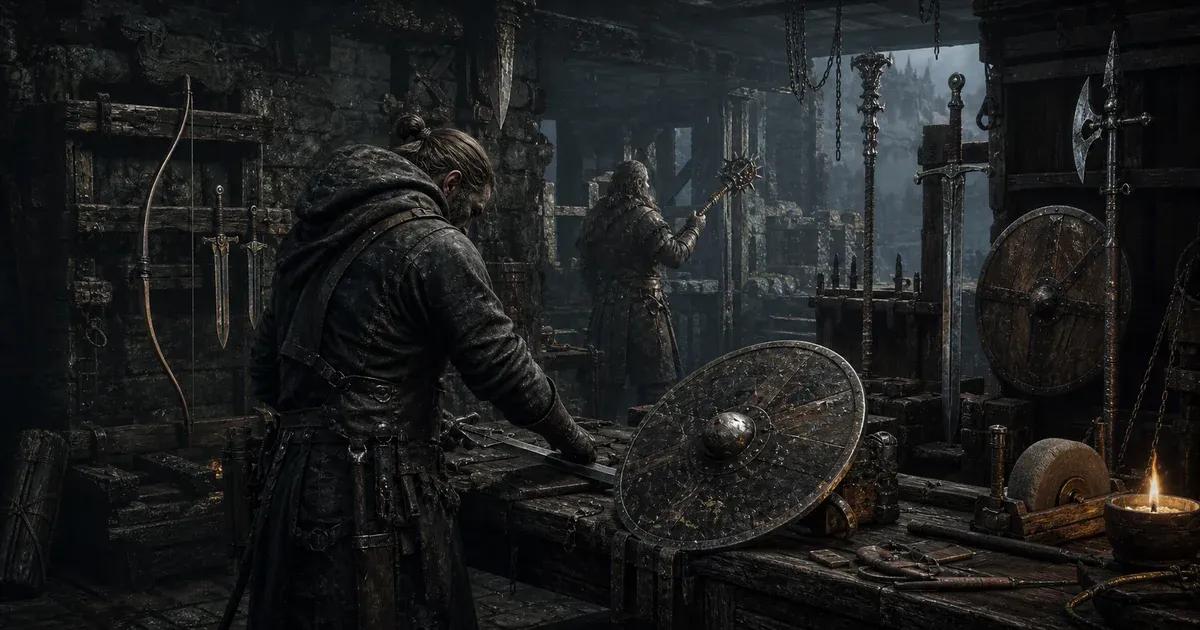
Mistfall Hunter does not use one shared weapon pool that every class can equip. Your class determines its available weapon branch, and that branch determines its core attacks and many of its skills. This guide separates the current release catalogue from older beta footage and avoids publishing numerical rarity bonuses that the reviewed sources do not establish.
Weapon types and class restrictions
The current player-facing catalogue has ten regular weapon branches across six classes. Blackarrow also has a Javelin recorded in the database as a special weapon entry, but the current class guides consistently treat Bow as its normal branch.
| Class | Current weapon branch | What changes when you choose it |
|---|---|---|
| Mercenary | Sword and Shield or Hammer | Sword and Shield emphasizes active defense and counterplay; Hammer trades speed for committed attacks, pressure, and crowd control |
| Blackarrow | Bow | Charged basic shots, specialty arrows, and ranged repositioning define the normal loadout |
| Shadowstrix | Dagger or Dual Blades | Dagger supports ambush and reset play; Dual Blades supports mobile, sustained melee pressure |
| Sorcerer | Staff | The weapon remains a Staff while the spell loadout shifts between Elemental and Stardust magic |
| Seer | Catalyst or Mace | Catalyst belongs to the supportive Reverent path; Mace belongs to the aggressive Blasphemer path |
| Withered Knight | Greatsword or Polearm and Shield | Greatsword favors committed offense; Polearm and Shield adds blocking, reach, and control |
These are class restrictions, not loose recommendations. A Mercenary cannot simply equip a Sorcerer Staff, and changing from Hammer to Sword and Shield is more than a cosmetic stat swap: it changes the combat framework you are preparing around. For a class-by-class explanation, see the classes guide.
How weapon paths affect your loadout
Most classes express their alternate playstyle through a second weapon branch. Sorcerer is the exception in the reviewed catalogue: it keeps a Staff and changes its spell school. Blackarrow’s current normal path likewise remains Bow, with build variety coming from arrows, skills, talents, and affixes rather than a second standard weapon.
Seer’s two paths are also tied to its oath choice. Catalyst supports the Reverent framework of runes, healing, shielding, and control. Mace belongs to Blasphemer, the melee framework. Treat those as separate loadouts; the collected evidence does not support combining both weapon identities in one expedition.
The exact attacks and talent interactions are too detailed to reproduce safely in a catalogue page and are more sensitive to patches. Use the individual build guides for the current practical choices:
- Mercenary: Hammer and Sword and Shield
- Blackarrow: Bow, arrows, and ranged skills
- Shadowstrix: Dagger and Dual Blades
- Sorcerer: Staff with Stardust or Elemental magic
- Seer: supportive Catalyst framework
- Blasphemer: Seer’s Mace framework
- Withered Knight: Greatsword and Polearm and Shield
What are the weapon rarity tiers?
The current database records seven rarity labels:
- Damaged
- Common
- Rare
- Excellent
- Epic
- Legendary
- Holy
GameTrek’s current player catalogue starts at Common and shows a named progression through Holy for each regular weapon branch. MistfallDB additionally records Damaged equipment. The two catalogues therefore support the labels, but they do not support a universal percentage such as “Rare is always 30% stronger” or a fixed number of affix slots for every weapon.
Compare the actual item card instead of assuming the color decides everything. Core attack values, durability, defensive statistics on shield weapons, affixes, sockets, and special effects can all affect whether an item fits a loadout. Holy entries in the reviewed catalogue can have weapon-specific effects, so two weapons at that rarity are not interchangeable.
How affixes work with weapons
Affixes are passive bonuses grouped by the reviewed launch guide into attack, defense, and utility categories. They can come from the gear itself, compatible gems, and a pre-run Tavern brew. Affixes stack, and that guide reports that many gain an additional benefit around level five.
That does not create one universal “best affix per weapon” table. A damage-over-time Blackarrow, a defensive Sword-and-Shield Mercenary, and a support Seer solve different problems even when all three can benefit from broadly useful attack, defense, or mobility bonuses.
One category is worth ruling out early: crit. An affix database records the only affix that raises Critical Damage as rolling on no gear at all, so damage from headshots is something you aim for rather than something you gear for. The critical hit guide covers the weak-point model, the two crit affixes that do roll, and the +48% ceiling on affix scaling.
Use this order when evaluating a weapon:
- Confirm that the weapon belongs to the class and framework you intend to play.
- Check whether its core and special effects support the skills in that loadout.
- Count the complete affix plan across equipment, gems, and Tavern buffs instead of judging the weapon in isolation.
- Compare the actual displayed values with your current item; do not assume rarity alone guarantees an upgrade.
- Test the loadout before risking an expensive set in a higher-intensity expedition.
The best-weapons comparison gives a dated community snapshot. The individual build pages give the more useful affix priorities because they can tie each recommendation to a specific skill package and mode.
How do you get and improve weapons?
Current guides describe three connected routes:
- Extraction runs: weapons can be found with the other loot you collect in a hunting ground, but they must leave the run with you to become useful inventory.
- Forge crafting and upgrading: the Forge turns recovered resources into equipment and upgrades, and higher Forge levels unlock better crafting tiers and more queue capacity.
- Player economy: the Auction House can provide a specific weapon or material when random drops and crafting do not produce the needed piece.
One current catalogue says Holy weapons drop from map bosses. That is useful acquisition guidance, but boss pools and reward rules can change; verify the current boss and item descriptions in game before farming one named effect exclusively. The boss fight guide covers the wider preparation loop.
What changed since the beta footage?
The pre-release class video remains useful for understanding each class’s identity, but it is not a complete current weapon list. In that build, Withered Knight exposed only part of its planned toolkit, while the current catalogues include both Greatsword and Polearm and Shield. Current sources also expose post-launch rarity entries and named Holy effects that the beta overview could not document.
When an older video and a current catalogue differ, this page uses the current catalogue for availability and treats the video as historical design context. Damage coefficients, cooldowns, drop pools, and balance rankings still need rechecking after patches.
Sources reviewed
- MistfallDB weapon database — current weapon records, class restrictions, rarity labels, named items, and special entries.
- GameTrek: List of All Weapons — current class-by-class catalogue and acquisition overview, last updated August 14, 2026.
- Legacy Gaming: Tips, Tricks, and Game Knowledge — post-launch explanation of equipment crafting, gems, Tavern buffs, and affix thresholds.
- All Six Classes Explained — pre-release beta footage used only for historical class and weapon-path context.